Permissions, properly
tl;dr
`rwx` in three groups: owner, group, everyone else. Read 4, write 2, execute 1 — so 754 and `rwxr-xr--` are the same sentence. And `777` is a confession, not a fix.
You've been running chmod 644 and chmod 600 on faith. Here's what the
numbers say.
ls -la prints something like -rw-r--r--. Those letters are read,
write and execute — x rather than e, for no good reason — arranged
in three groups:
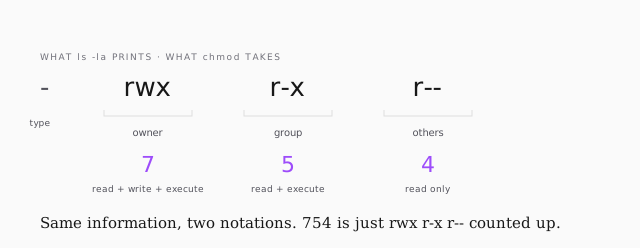
Owner is you. Group is the groups you belong to — on your server that's
sudo, since it's the only one you joined. Others is everyone else.
So app.js at -rw-rw-r-- reads: I can read and write it; my group can read and
write it; everyone else can only read. No execute anywhere, because you don't
run it directly — node does.
The arithmetic
Octal, base 8:
| read | 4 |
| write | 2 |
| execute | 1 |
Add them per group and you get the digit. That's all there is.
600— only I can read and write. Nobody else does anything. This is what SSH demands of a private key, and now you know why it's that number.644— I read and write, everyone reads.755— I do everything, everyone reads and executes. Directories usually.777— 4+2+1 three times. Anyone, anything, anywhere.
Least privilege, and whose fault it is
The rule is to grant the fewest permissions that let the work happen.
Jem's framing is the one worth keeping: if you leave a glass vase where a child
can reach it and it breaks, that's on you. If a user on your server can
rm -rf / because you gave them permission to, the outcome is yours. The
permission you granted is the decision you made.