
Operating systems, and why Ubuntu
tl;dr
Two families: Windows and Unix. Your Mac and your droplet are cousins, which is why the commands transfer. A Unix system is programs, a kernel, and a rule — everything is a file or a process.
There are essentially two families. Windows, which for servers means Windows Server and nothing much else — you could run a consumer build, but don't. And Unix, which has every flavour you can imagine.
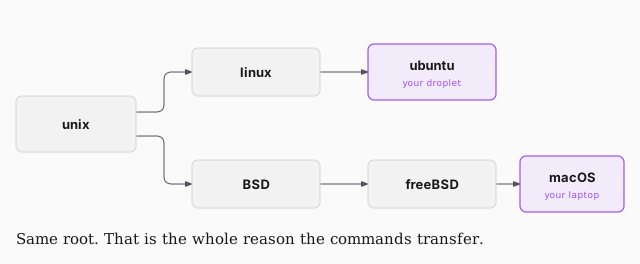
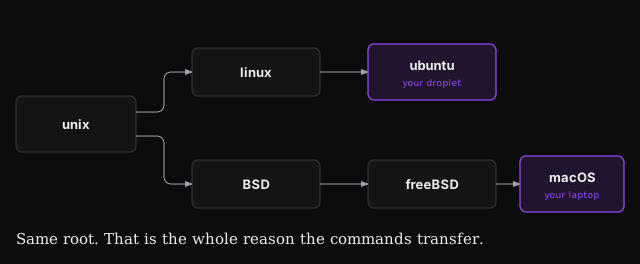
This is the answer to a question you may not have thought to ask: why do the commands you just learned on your laptop work on a server you haven't bought yet? Because macOS and Ubuntu are both Unix underneath.
Which Linux
Linux is the friendliest, most accessible branch, with far more built-in commands — and by far the most versions. Debian, CentOS, Ubuntu, Fedora, Red Hat, Alpine, Arch. There's a flavour for whatever you're doing, because it's endlessly customisable.
Pick Ubuntu. It's the most common and most popular, it's a safe bet, and you won't hit anything that isn't already documented.
Most of them are open source and free — Red Hat being the exception. Which is worth sitting with for a second: an entire category of foundational software, built collaboratively, given away.
What an operating system is made of
In Unix terms, three parts nested inside each other:
- Programs and utilities —
mkdir,rmdir,vi. These are the OS as far as you're concerned. - The kernel — the part that talks to the hardware. Going in there is hardware programming, which is computer engineering rather than software engineering. We stay in user land.
- The shell in between, which you already met.
Finishing the droplet
Back on DigitalOcean: Ubuntu, LTS, 64-bit, and the smallest, cheapest droplet size. You are not building Netflix 2.0 today and the compute doesn't matter.
The cheapest option isn't in every data centre — the $4 tier shows up in New York but not always in San Francisco, so if cost is what you care about, pick the region that has it. Expect somewhere around $4–6 a month.
Which leaves one question. You have a machine. How do you get into it?
You could use a password. You're about to see why you won't.