Hashing with salt
tl;dr
Longer hashes buy time, not safety — the rainbow table just gets bigger. A random salt per user is what actually breaks it, and rolling your own crypto is what breaks you.
MD5 gives you 33 characters. SHA-1 gives 41. SHA-256 gives 65 — currently the gold standard, and enough entropy that storing every precomputed answer starts to blow up memory.
But note what hasn't changed: you and I still get the same output for the same
password. A longer hash makes the rainbow table more expensive, not
impossible. Tables of common SHA-1 patterns — password, p@ssword,
password1 — already exist. There are people who do this full time.
The salt
A salt is just randomness: a random number, unique to that record at the time it was created. You take the input, add the salt, and hash the pair.
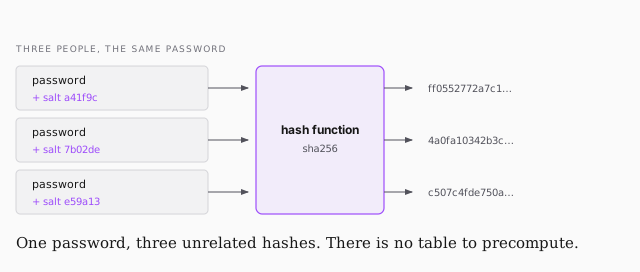
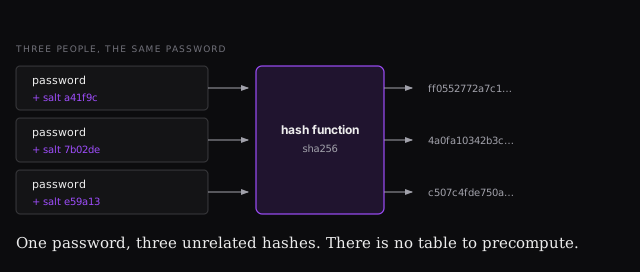
That's the whole trick, and it costs almost nothing to implement. The password becomes unrecognisable, and no one can build a table for it — because they'd need a separate table per salt.
The salt itself can be anything random. Math.random() run through a hash
function, combined with the input, and passed to the cryptographic hash.
Things people still get wrong
Jem spends a long time here for a reason: this is where breaches come from.
- Storing passwords in plain text. Still happens. Constantly.
- "I hashed it with MD5." You've now seen why that isn't security.
- "I'll just MD5 it ten times." Computers do that trivially too. Repetition isn't entropy.
The only real answer is a strong cryptographic function with a random salt per user. Then even if someone takes the whole password database, it's gibberish — they can't reverse the hash and they don't have the salts.
Why a cryptographic hash is different
A plain hash function can often be reversed if you know the function — MD5 particularly easily. A cryptographic hash is built so that it can't be, and that's the distinction the word "cryptographic" is carrying.
MD5 isn't useless, by the way. It's still fine for verifying a file arrived intact — hash it on both ends and compare. Just never for passwords.